

With the median Layton home built in 1993, your heating system is likely facing its second or third retirement crisis right now. Understanding the common furnace problems in Layton homes is the best way to stay ahead of the cold. It’s frustrating when the temperature drops and your vents start blowing chilly air or making strange noises. We know the anxiety that comes with a failing unit. You worry about high replacement costs, or even worse, the hidden danger of carbon monoxide leaks. It’s a lot to handle when you just want a warm, safe house for your family.
We’re here to help you pinpoint exactly why your system is acting up before it turns into an expensive emergency. Whether it’s a failed flame sensor or a blower motor worn out by those freezing east bench winds, we’ve got the answers you need. This guide offers a clear diagnostic of what’s going wrong and explains how to fix these issues quickly. We’ll walk through everything from simple filter fixes to the specific challenges of aging local housing so you can get back to being cozy without the stress.
Key Takeaways
- Understand how Layton’s specific elevation and the 1990s housing boom impact your heating system’s performance.
- Spot the signs of the five most common furnace problems in Layton homes, including ignition failures and pressure issues.
- Learn how to audit your furnace’s maintenance history if you’ve recently moved near Hill AFB to avoid winter surprises.
- Master the 15-year rule to determine if a quick repair or a high-efficiency replacement makes the most financial sense.
- Discover why a professional, mess-free service approach keeps your home comfortable while respecting your living space.
Why Layton Homes Face Unique Furnace Challenges
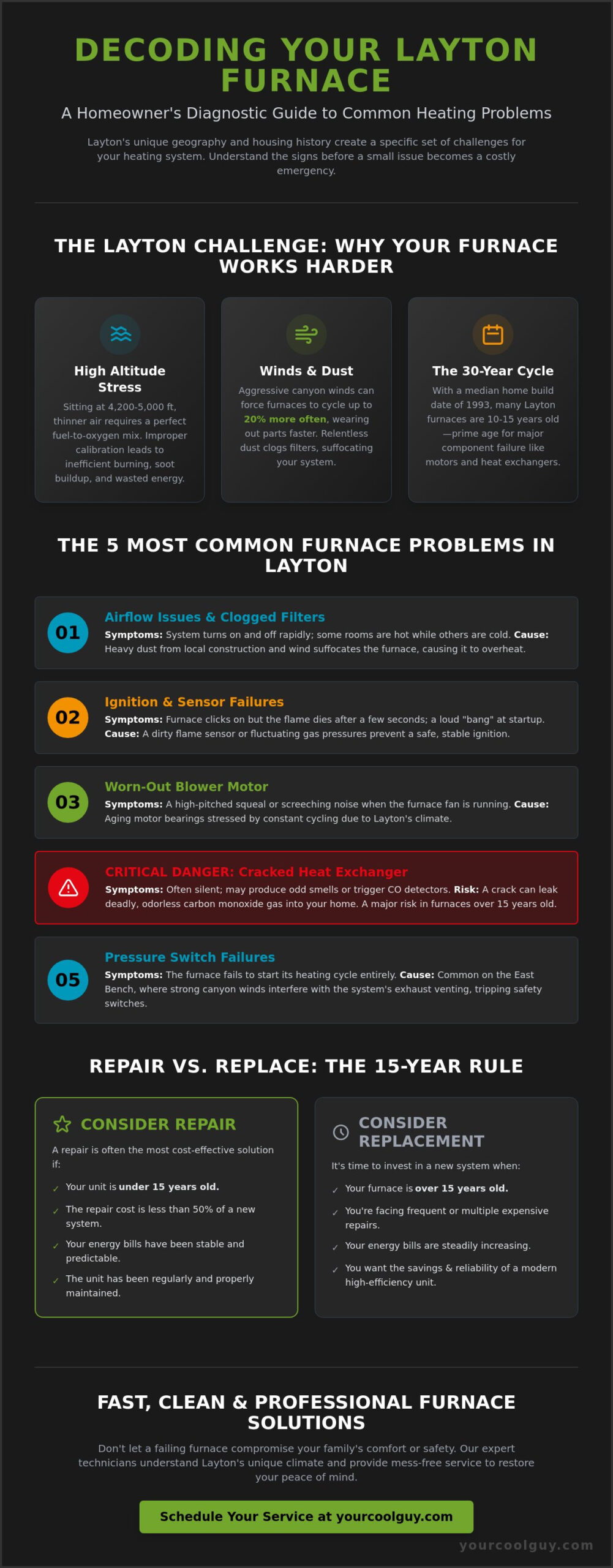
Layton isn’t just another suburb; its geography and history create a specific set of hurdles for your HVAC system. Sitting between 4,200 and 5,000 feet, our city deals with thinner air that directly impacts how fuel burns. Thinner air means your furnace needs a precise oxygen-to-gas ratio to operate safely. If your system wasn’t properly calibrated for this altitude during installation, you’ll likely encounter common furnace problems in Layton homes like soot buildup or inefficient combustion. Understanding how modern furnaces work helps you realize that airflow is a matter of chemistry, not just comfort.
The local landscape adds another layer of stress. If you live near Adams Canyon, you know the wind doesn’t just blow; it pours. Cold air drainage from the mountains creates a microclimate that can force furnaces to cycle up to 20% more often than homes further west. This constant starting and stopping puts immense pressure on your igniter and blower motor. Combine this with the relentless dust from ongoing Davis County development, and your system is fighting a battle against clogged filters and internal wear every single day.
The 30-Year Equipment Cycle in Layton
Layton’s massive housing boom in the 1990s has created a unique “second-cycle” failure window for local homeowners in 2026. Most original furnaces from that era have already been replaced once, meaning many current units are now 10 to 15 years old and reaching their breaking point. We’re seeing a widespread wave of blower motor failures and cracked heat exchangers as these systems struggle to keep up. The second-cycle replacement trend describes the current wave of homeowners replacing their second heating unit as 1990s-era homes reach their 30th year of service. Transitioning from old 80% AFUE models to modern high-efficiency systems is becoming a necessity rather than a luxury for these aging neighborhoods.
East Bench vs. Valley Floor Heating Needs
Elevation changes near SR-193 aren’t just about the views; they change how your furnace “feels” the air. Homes on the East Bench often face pressure switch failures because aggressive canyon gusts can actually interfere with the venting process. Down on the valley floor near the Great Salt Lake wetlands, the challenges shift toward higher humidity and potential salt-air corrosion. These distinct microclimates mean that one-size-fits-all furnace settings usually fail. Your system needs to be tuned specifically for your street’s elevation and exposure to ensure it doesn’t overwork itself during a cold snap. We focus on these local details to make sure your home stays warm without the messy, expensive surprises of a total system breakdown.
The 5 Most Common Furnace Problems in Layton Homes
Identifying common furnace problems in Layton homes starts with listening to your unit. Our local environment, from the salty air near the lake to the relentless canyon winds, creates specific mechanical stresses. While some issues are simple fixes, others require a professional eye to prevent a total system failure during a January freeze. Staying proactive about maintaining your furnace is the best way to avoid the anxiety of a midnight breakdown.
Airflow Issues and Filter Clogs
Davis County dust is relentless. Between new construction in West Layton and the seasonal wind storms, your air filters work overtime. When a filter becomes completely restricted, your furnace effectively suffocates. This lack of airflow causes the heat exchanger to overheat, which trips the limit switch. If you notice your furnace turning off and on rapidly, or if some rooms feel like ice boxes while others are sweltering, a clogged filter is the likely culprit. Changing your filter every 30 to 90 days is a non-negotiable part of living in this part of Utah.
Ignition and Sensor Problems
A furnace that starts for a few seconds and then abruptly dies is usually suffering from a dirty flame sensor. This tiny metal rod tells the system that it’s safe to keep the gas flowing. In Layton, fluctuating gas manifold pressures can also lead to delayed ignition. You might hear a loud “bang” when the furnace kicks on; that’s the sound of excess gas igniting all at once. If you’re hearing these noises, it’s a good idea to have a technician perform a professional furnace repair to recalibrate your ignition system before it wears out the entire assembly.
Beyond sensors and filters, we frequently encounter the “Layton Screech.” This high-pitched squeal usually comes from aging blower motor bearings that have been pushed to their limit by the 1990s housing cycle. For those living in older homes, the most serious concern is a cracked heat exchanger. As units from the 1993 boom reach their 30th year, the metal can fatigue and crack, posing a genuine carbon monoxide risk. We also see many “smart” thermostat upgrades that weren’t wired correctly, leading to miscommunications that cause the furnace to short-cycle and waste energy. Addressing these issues early keeps your home warm and your utility bills predictable.
The Hill AFB Factor: Inherited Furnace Problems
Approximately one in six households in Layton is connected to Hill Air Force Base. This high concentration of military families creates a unique real estate environment where homes change hands frequently. For many new residents, the PCS (Permanent Change of Station) cycle means moving in during the late spring or summer. You might spend months enjoying the mountain views before you ever think about your thermostat. This gap in time often hides common furnace problems in Layton homes until the first major cold snap arrives in October or November.
Inheriting a home near the south or east gates often means inheriting a mechanical mystery. Unlike a car with a service log in the glovebox, residential furnaces rarely come with a detailed maintenance history. If the previous owner was focused on a quick move, they might have skipped the annual tune-up. This lack of data can lead to unexpected failures when the system is finally pushed to its limit. If you find that your inherited unit is struggling, upgrading to ENERGY STAR certified furnaces can provide the reliability and efficiency that an older, neglected system lacks.
What to Check When You Move In
Don’t wait for a blizzard to audit your new home’s heating system. Start by looking for a service sticker on the side of the furnace cabinet. This tells you exactly when a professional last inspected the unit. Next, take a look at the exhaust venting. Our intense canyon winds can sometimes dislodge or loosen flue pipes in the attic or where they exit the roof. To ensure your home’s total exhaust safety, you can explore Chimney Inspection as part of your move-in checklist. Finally, test every carbon monoxide detector in the house. Since you don’t know the internal condition of the heat exchanger yet, these sensors are your family’s first line of defense against invisible leaks.
Safety First for New Homeowners
Every member of the household should know the location of the gas shut-off valve. It’s usually a small handle located on the gas line right next to the furnace. When you turn the heat on for the first time, a slight “dusty” smell is normal as the burners singe off summer accumulation. However, if you smell rotten eggs or hear persistent metallic banging, shut the system down immediately. For any situation that feels unsafe or leaves you without heat during a freeze, you can rely on Emergency HVAC Repair in Davis County to get your home back to a safe temperature. Taking these steps early ensures your transition to Layton is warm, comfortable, and completely stress-free.
Repair vs. Replace: Making the Right Call in 2026
Deciding whether to keep patching up your unit or invest in a new one is a major financial crossroads for many local families. In 2026, the decision often comes down to the 15-year rule. If your system was installed during the mid-2000s or earlier, it’s likely reaching the end of its reliable lifespan. While common furnace problems in Layton homes can often be fixed, the “Band-Aid” trap is real. Spending several hundred dollars every winter on igniters, sensors, or capacitors eventually costs more than a modern, worry-free system. Many military families arriving in Layton on PCS orders face this dilemma immediately when they inherit a neglected unit.
Safety is the ultimate dealbreaker. A cracked heat exchanger isn’t just a repair issue; it’s a serious carbon monoxide hazard. Because these cracks are often invisible to the naked eye, a professional diagnostic is essential for any unit over 15 years old. If your unit has a breach, we always recommend a full replacement to protect your family. Modern systems offer much better peace of mind than a 30-year-old unit from the 1993 housing boom.
The Cost of Inefficiency
Old 80% AFUE furnaces waste 20 cents of every dollar you spend on gas. Upgrading to a 96% or higher AFUE model significantly cuts your monthly bills. In Layton, homeowners can take advantage of Enbridge Gas rebates, which offer $300 for 95% to 97.4% AFUE systems and $350 for those 97.5% or higher. For the ultimate efficiency, many are switching to dual-fuel systems. These pair a high-efficiency electric heat pump with a natural gas furnace, qualifying for combined rebates from Enbridge and Rocky Mountain Power that can reach over $3,000. Investing in a furnace installation in Ogden and the surrounding Davis County areas ensures your home stays warm while your energy costs drop. Modern variable-speed blowers also handle those aggressive canyon wind drafts much better than old single-stage motors.
Signs Your Furnace is Ready to Retire
Your furnace usually gives warning signs before it quits entirely. Look at your pilot light; a healthy flame is crisp blue. A yellow or flickering flame suggests improper combustion and potential soot buildup. Listen for a loud “boom” or “bang” when the heat kicks on. This indicates delayed ignition, which can damage the burner assembly over time. Finally, if your multi-level Layton floor plan has massive temperature swings between the basement and the top floor, your old unit likely lacks the power to circulate air effectively.
If you’re tired of high bills and cold rooms, it’s time for a professional furnace installation that respects your home and your budget.
Fast & Clean Furnace Solutions with E.R.S. Heating & Cooling
Dealing with common furnace problems in Layton homes shouldn’t feel like a second job. When your heating system fails during a Davis County cold snap, you need a team that understands the local climate and the specific quirks of our housing stock. At E.R.S. Heating & Cooling, we’ve spent over 20 years mastering the art of furnace repair and installation across Davis and Weber Counties. We’ve seen every issue from canyon-wind-damaged venting to the “second-cycle” failures of 1990s-era blower motors. Our mission is simple: we get your heat back on quickly without making a mess of your living space.
The “Fast & Clean” promise is the heartbeat of our business. We know that inviting technicians into your home can sometimes be a headache, especially if they leave behind dirt or take all day to diagnose a simple issue. We respect your home like it’s our own. Our technicians arrive on time, use floor protection, and work with a level of precision that keeps your house tidy. Whether you need a midnight 24/7 emergency response or a scheduled system upgrade, we focus on a smooth, professional experience that takes the stress out of home maintenance.
Why Layton Trusts E.R.S.
As a family-owned and operated company, our values are rooted in the community. We aren’t a giant, faceless corporation; we’re your neighbors. We understand the unique heating needs of neighborhoods from Layton Hills to Heritage Park. This local expertise allows us to provide direct, honest advice rather than a generic sales pitch. You get access to technicians who truly care about your comfort and safety. We’ve built our reputation on transparency and the kind of high-quality work that earns a permanent spot in your contacts list.
Schedule Your Layton Furnace Tune-Up
Prevention is always cheaper than a midnight emergency. A professional E.R.S. furnace inspection goes deep into the mechanics of your system. We don’t just look at the filter; we test the heat exchanger for cracks, clean the flame sensors, and verify that your gas manifold pressure is calibrated for Layton’s elevation. This proactive care is the best way to extend the life of your 1990s-era equipment and keep those common furnace problems in Layton homes at bay. Don’t wait for the next canyon wind storm to find out if your system can handle the pressure. We make sure your unit is ready for whatever the Wasatch Front throws at it.
Schedule your fast and clean furnace repair today!
Secure Your Home’s Comfort Today
You shouldn’t have to guess why your vents are blowing cold air or making strange noises during a Utah freeze. From the unique demands of East Bench canyon winds to the aging systems found in our 1990s housing boom, common furnace problems in Layton homes are manageable when you have the right team by your side. We’ve explored how to spot early warning signs and when it’s finally time to trade that old unit for a modern, high-efficiency model. Staying proactive is the best way to avoid the stress of a mid-winter breakdown.
At E.R.S. Heating & Cooling, we bring over 20 years of local experience to every doorstep in Davis County. We offer 24/7 emergency support because we know the cold doesn’t wait for business hours. Our Fast & Clean Service Guarantee ensures you get expert results without a messy aftermath or long wait times. Don’t let a small glitch turn into an expensive emergency for your family. We’re here to make sure your heating system is reliable, efficient, and ready for anything.
Get Fast & Clean Furnace Repair in Layton Now. We look forward to helping you keep your home warm and your family safe all season long!
Frequently Asked Questions
How often should I change my furnace filter in Layton?
You should change your filter every 30 to 90 days depending on your home’s activity level. Because Davis County experiences significant dust from canyon winds and local construction, checking your filter monthly is the safest habit. A clean filter prevents common furnace problems in Layton homes by ensuring the system doesn’t overheat or trip the limit switch during a cold snap.
Why is my furnace making a loud banging noise when it starts?
This sound usually indicates delayed ignition. It happens when gas builds up in the combustion chamber before the igniter finally kicks in, causing a small, controlled explosion. This often stems from dirty burners or fluctuating gas pressure. Both issues require professional calibration to prevent the vibration from eventually damaging your heat exchanger.
Is it worth repairing a 20-year-old furnace in a Layton home?
Usually, it isn’t cost-effective to perform major repairs on a unit that has hit the 20-year mark. At this age, the heat exchanger is at a high risk for cracking, and most internal components are near the end of their mechanical life. Investing in a modern system often pays for itself through lower utility bills and available 2026 utility rebates.
What are the signs of a cracked heat exchanger?
Look for a flickering yellow pilot light, excessive soot, or a strong chemical odor similar to formaldehyde. You might also notice your carbon monoxide detector going off or family members suffering from unexplained headaches. Since this is a major safety hazard, you should shut down the system immediately and call for a professional inspection if you suspect a crack.
Why does my furnace keep blowing cold air?
This is frequently caused by a dirty flame sensor or a pilot light that has gone out. If the sensor can’t detect a steady flame, it shuts off the gas for safety while the blower motor continues to run. This results in unheated air being pushed through your vents. Check your thermostat first to ensure the fan isn’t set to “On” instead of “Auto.”
Do canyon winds really affect my heating system performance?
Yes, aggressive winds from Adams Canyon can create backdrafts or interfere with your furnace’s pressure switch. These gusts can actually push exhaust back into the flue or prevent the system from venting properly. This causes the furnace to shut down as a safety precaution. Homes on the East Bench often need specialized tuning to handle these local microclimates.
What should I do if I smell gas near my furnace?
Leave the house immediately and call your gas provider or emergency services from a safe distance. Do not flip any light switches, use your phone inside, or try to find the leak yourself. Once the area is cleared by utility professionals, we can help identify and repair the mechanical failure that caused the leak in the first place.
How can I lower my heating bills during a Davis County winter?
Upgrading to a programmable thermostat and sealing leaky ducts are the most effective ways to save. You should also take advantage of Enbridge Gas rebates for high-efficiency furnaces to lower your initial investment. Regular maintenance ensures your system runs at peak efficiency, preventing common furnace problems in Layton homes that drive up energy consumption.