

Your walk-in cooler just stopped holding temperature at 11 PM on a Tuesday, and thousands of dollars in inventory are already at risk. Sound familiar? If you run a restaurant, grocery operation, or medical facility in northern Utah, you already know that a cooling failure isn’t a minor inconvenience; it’s a business emergency. Finding reliable commercial refrigeration repair in Ogden, UT fast enough to actually matter is the real challenge, and the wrong technician can make a bad day even worse by showing up late, quoting surprise fees, or leaving your kitchen looking like a construction site.
You’re right to be frustrated. The stakes are high, the options feel unclear, and most service providers treat your workspace like it’s their own personal workshop. This guide is here to change that. You’ll learn how to spot cooling problems early, understand the real cost of waiting too long, and know exactly what to look for in a commercial refrigeration technician who treats your space with the same respect you do.
From walk-in cooler diagnostics to reach-in freezer repairs and specialized cryogenic equipment service, here’s everything an Ogden business owner needs to protect their inventory, their budget, and their peace of mind.
Key Takeaways
- Ogden’s high altitude and dry climate create unique stress on commercial cooling systems, making local expertise critical when things go wrong.
- Knowing the early warning signs of a failing unit can be the difference between a quick repair and a full inventory loss — this article shows you exactly what to watch for.
- The “50% Rule” is a simple but powerful framework that helps you decide whether to repair or replace, and when a newer unit can actually pay for itself within 18 months.
- When your system fails, the first 30 minutes matter most — you’ll learn the immediate steps to protect your inventory before a technician even arrives.
- Finding reliable commercial refrigeration repair in Ogden, UT means knowing what to demand from your technician: speed, transparency, and a workspace left cleaner than they found it.
The Stakes of Commercial Refrigeration in Ogden, UT
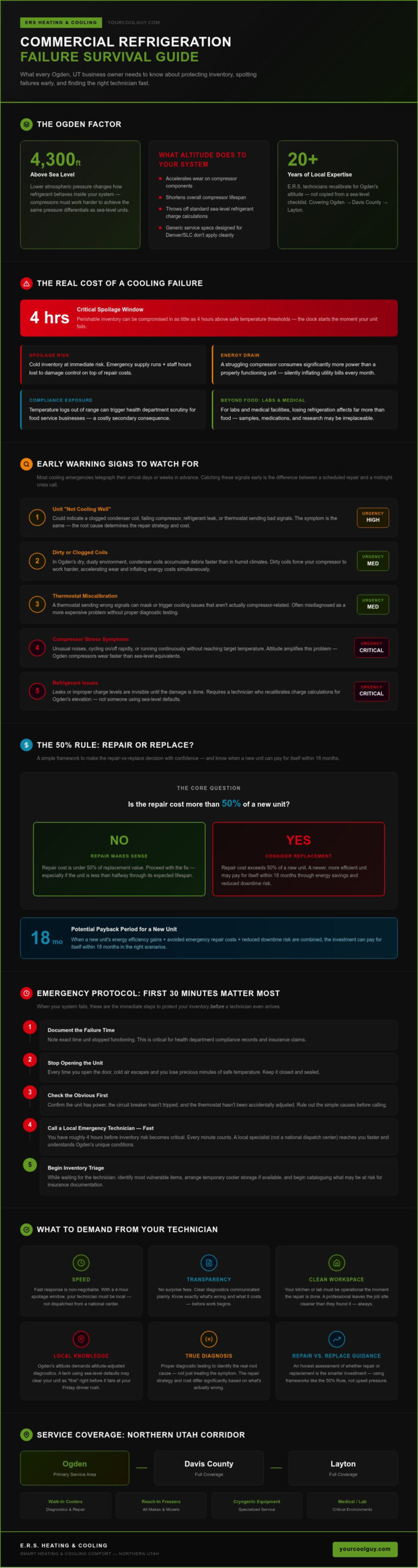
Ogden isn’t just another Utah city. At roughly 4,300 feet above sea level, with a dry climate that swings hard between seasons, your commercial cooling equipment is working against conditions that most generic service providers simply aren’t trained to handle. That gap in expertise is exactly where businesses get hurt, and it’s why finding the right commercial refrigeration repair in Ogden, UT matters more than most owners realize until something goes wrong.
E.R.S. Heating & Cooling, known locally as YourCoolGuy, has spent 20+ years working specifically in this environment. That’s not a corporate talking point; it’s the difference between a technician who recalibrates for altitude and one who copies a checklist designed for sea-level systems. The service area spans Ogden through Davis County and into Layton, covering the full corridor of northern Utah businesses that share these same atmospheric challenges.
The “Ogden Factor”: Altitude and Your Compressor
Higher altitude means lower atmospheric pressure, and lower pressure changes how refrigerant behaves inside your system. At 4,300 feet, compressors work harder to achieve the same pressure differentials they’d hit effortlessly at sea level. That extra strain accelerates wear on components, shortens compressor lifespan, and throws off the refrigerant charge calculations that a technician calibrated for Denver or Salt Lake might use by default.
Generic maintenance plans don’t account for this. They’re built on standardized pressure specs that don’t translate cleanly to Ogden’s elevation. A tech who doesn’t adjust for local atmospheric conditions might clear your unit as “running fine” right up until it fails during your Friday dinner rush. Local knowledge isn’t a bonus feature; it’s a baseline requirement.
Protecting the Bottom Line: Spoilage vs. Service
A single 24-hour cooling failure can put a restaurant’s entire cold inventory at risk. Beyond the immediate spoilage, there’s the health inspection exposure, the emergency supply run, and the staff hours lost to damage control. That’s before you factor in the energy cost of a unit that’s “limping along” at reduced efficiency, which quietly inflates your utility bills every month while you delay the call.
- Spoilage risk: Perishable inventory can be compromised in as little as 4 hours above safe temperature thresholds
- Energy drain: A struggling compressor can consume significantly more power than a properly functioning unit
- Compliance exposure: Temperature logs out of range can trigger health department scrutiny for food service businesses
- Downtime cost: For labs and medical facilities, losing refrigeration affects far more than food
The YourCoolGuy approach treats your workspace with the same respect you do: fast diagnostics, transparent communication, and a commitment to leaving the job site cleaner than they found it. That last part sounds small. It isn’t, especially when your kitchen or lab needs to be operational the moment the repair is done.
Common Failure Points in Commercial Cooling Systems
Most cooling emergencies don’t come out of nowhere. They telegraph their arrival for days, sometimes weeks, through symptoms that are easy to dismiss when you’re busy running a business. Catching those signals early is the difference between a scheduled repair and a midnight crisis call. Here’s what actually breaks, why it breaks, and how to tell the difference between a minor fix and a system on its last legs.
The most common culprits behind commercial refrigeration failures fall into a predictable pattern: dirty coils, thermostat miscalibration, compressor stress, and refrigerant issues. The tricky part is that these problems mimic each other. A unit that’s “not cooling well” could mean a clogged condenser coil, a failing compressor, a refrigerant leak, or a thermostat sending bad signals to the whole system. Diagnosing the real culprit matters because the repair strategy, and the cost, changes significantly depending on the root cause.
Evaporator and condenser coil cleanliness is one of the most underestimated factors in system reliability. Dirty coils force your compressor to work harder to move heat, accelerating wear and inflating energy consumption simultaneously. In Ogden’s dry, dusty environment, condenser coils accumulate debris faster than in more humid climates, making regular cleaning a genuine operational priority rather than optional maintenance.
Walk-In Coolers and Freezers: Beyond the Door Seal
Frost buildup inside a walk-in cooler isn’t just an aesthetic issue. It’s a symptom. Excessive frost on evaporator coils typically points to a defrost cycle failure or a humidity infiltration problem, often traced to a worn door gasket or a door that’s not sealing flush. Left unchecked, frost accumulation restricts airflow across the coils, which compounds the cooling problem and puts sustained strain on the compressor.
Short-cycling is a separate concern that gets worse during Ogden’s hot summers. When a compressor turns on and off in rapid succession without completing a full refrigeration cycle, it’s usually responding to overheating or an electrical fault. Each short cycle puts mechanical stress on the compressor’s start components, and repeated starts without full cycles shorten its lifespan considerably. Unusual sounds, specifically grinding, rattling, or a high-pitched squeal on startup, are the clearest audible indicators that mechanical failure is approaching.
- Frost on coils: Defrost cycle failure or humidity infiltration
- Short-cycling: Overheating, electrical fault, or refrigerant pressure issues
- Grinding or squealing on startup: Compressor bearing wear; treat as urgent
- Temperature drift without obvious cause: Often a thermostat sending incorrect signals before a compressor problem is diagnosed
Specialized Systems: Ice Machines and Cryogenics
Ice machines generate more emergency service calls than almost any other commercial refrigeration equipment. In Ogden specifically, the local water supply’s mineral content accelerates scale buildup inside the machine’s water lines, distribution tubes, and evaporator plate. Scale restricts water flow, reduces ice production, and eventually causes the machine to lock out entirely. Regular descaling isn’t just recommended; it’s the single most effective way to avoid an ice machine emergency during your busiest service period.
Cryogenic equipment is a different category entirely. These systems operate at extreme temperature ranges that standard refrigeration training doesn’t cover, and an incorrect repair can compromise both the equipment and the materials stored inside. For labs, medical facilities, and specialty operations in northern Utah, cryogenic equipment service from a qualified technician isn’t an upgrade; it’s a baseline safety requirement. The technical gap here is exactly where inexperienced providers cause the most damage.
Reach-in coolers look simple but have a consistent weak point: airflow. Overcrowded shelving, blocked vents, and dirty condenser coils at the base of the unit create hot spots that force the system to run longer cycles than designed. The fix is often straightforward, but the problem gets misread as a refrigerant issue and over-repaired when proper diagnostics aren’t applied. When you’re searching for reliable commercial refrigeration repair in Ogden, UT, the ability to accurately distinguish between airflow, refrigerant, electrical, and mechanical failures is what separates a competent technician from an expensive one.
The 50% Rule: Deciding to Repair or Replace
Here’s the framework most service providers won’t give you: if a repair costs 50% or more of what a replacement unit would cost, and your equipment is more than halfway through its expected lifespan, replacement is almost always the smarter financial move. That’s the 50% Rule, and it cuts through the noise when you’re staring at a repair quote and trying to decide whether to sign off or walk away.
Commercial compressors in Utah’s high-altitude environment typically have shorter functional lifespans than manufacturer specs suggest, precisely because of the elevated workload discussed earlier. A unit that’s been running hard in Ogden for 10 years isn’t the same as a 10-year-old unit in a coastal city. That context matters when you’re applying the rule.
Evaluating Your Refrigeration ROI
Start tracking repairs by unit, not by month. A single expensive repair isn’t a pattern. Two mid-sized repairs within 12 months on the same unit is a pattern, and it’s the clearest signal that you’re funding a money pit rather than maintaining an asset. Pull your service history and do the math before your next technician visit.
Refrigerant type is another factor that changes the calculation. Older units running on R-22 refrigerant face a supply and cost reality that makes long-term operation increasingly expensive. Modern refrigerants used in current equipment are more widely available and operate more efficiently, which directly affects your monthly energy overhead. Upgrading to a newer unit isn’t just about avoiding breakdowns; it’s about reducing the ongoing cost of keeping product cold.
Tax incentives for energy-efficient commercial equipment upgrades do exist at the federal level under certain provisions, and Utah businesses should verify current eligibility with a tax professional. This is worth checking before you dismiss replacement as “too expensive.”
When Repair Is the Smart Choice
Not every repair conversation ends with a replacement recommendation. If your unit is under 7 years old, has a solid service history, and the failing component is a thermostat, a door gasket, or a condenser coil rather than the compressor itself, repair is almost certainly the right call. High-value components like evaporator coils and refrigeration cabinets retain their worth long after smaller parts wear out.
One thing that gets overlooked: a professional deep cleaning resolves a surprising number of issues that get misdiagnosed as mechanical failures. Restricted airflow from dirty coils mimics compressor strain convincingly enough to generate unnecessary replacement quotes. Before committing to a major repair or replacement, make sure diagnostics include a full coil inspection.
Proactive maintenance is where the real savings live. Businesses that schedule regular walk-in cooler maintenance and reach-in freezer service consistently avoid the catastrophic failures that force the repair-or-replace conversation in the first place. When you’re evaluating providers for commercial refrigeration repair in Ogden, UT, ask specifically whether they offer maintenance agreements, not just emergency response. The technicians worth hiring are the ones who’d rather keep your equipment running than show up for crisis calls.
Emergency Protocol: What to Do When Your System Fails
The first 30 minutes after a cooling failure are the most consequential. What you do before a technician arrives can be the difference between a manageable situation and a total inventory loss. Most service providers show up, fix the unit, and leave. Almost none of them tell you what to do while you’re waiting. That gap is where this section lives.
Inventory Preservation 101
The single most effective thing you can do right now: stop opening the door. A closed walk-in cooler retains its thermal mass far longer than most owners expect. Every time that door opens, you’re trading cold air for warm, and the temperature climbs faster than the unit can recover. Assign one person to manage access and enforce the rule without exceptions.
Dry ice is a legitimate short-term option for high-value inventory, but it comes with caveats. It works well for dense, solid product but doesn’t distribute cold air the way a functioning unit does. It also requires ventilation and careful handling. If you go this route, treat it as a bridge, not a solution, and prioritize the most temperature-sensitive items first.
Document everything. Take timestamped temperature readings from every affected unit and photograph your inventory status. This isn’t just good practice; it’s the foundation of any insurance claim and your defense during a health inspection. Utah food service businesses are required to maintain temperature logs, and a well-documented failure response demonstrates due diligence rather than negligence.
Choosing the Right Ogden Technician Under Pressure
When you’re under pressure, “cheap and fast” is a trap. A low-quoted technician who arrives without the right parts, leaves refrigerant residue on your kitchen floor, or applies a temporary fix that fails again in 72 hours costs you far more than the original quote suggested. For commercial refrigeration repair in Ogden, UT, the right questions to ask before you confirm a service call are straightforward: Are they licensed and insured in Utah? Do they have verifiable local experience, not just a local phone number? And will they tell you upfront what the diagnostic process looks like before billing starts?
When you call a dispatcher, be specific. “It’s not cooling” is less useful than “the compressor is running but the temperature has climbed from 38°F to 52°F over the last three hours and there’s frost on the evaporator coils.” That level of detail helps a qualified technician arrive with the right tools and likely the right parts.
The YourCoolGuy standard is built around one non-negotiable: your workspace gets left cleaner than it was found. That commitment matters in a commercial kitchen or medical facility where operational hygiene isn’t optional. A technician who respects your environment respects your business.
Don’t wait until the next failure to find out who you’re calling. Connect with YourCoolGuy now to have a trusted Ogden refrigeration technician in your contacts before you need one.
Why Ogden Businesses Trust E.R.S. (YourCoolGuy)
Twenty-plus years working in northern Utah’s specific conditions isn’t a resume line. It’s the reason YourCoolGuy diagnoses faster, fixes right the first time, and doesn’t leave you guessing about what just happened to your equipment. E.R.S. Heating & Cooling has built its reputation on one straightforward promise: fast work, clean results, and zero excuses. That combination is harder to find than it should be, and Ogden businesses know it.
The service range covers the full commercial spectrum. Ice machine descaling and repair, walk-in cooler maintenance, reach-in freezer diagnostics, and cryogenic equipment service for labs and medical facilities all fall under the same roof. You don’t need three different vendors with three different billing cycles. One call handles it.
The “Fast & Clean” standard isn’t marketing language. It’s a literal commitment to leaving your kitchen, lab, or storage space in better shape than it was before the technician arrived. No grease smears on your stainless steel. No refrigerant residue on your floor. No debris left behind because the job got done fast. When your space needs to be operational the moment repairs finish, that standard matters in a way that’s hard to overstate.
Family-Owned Values, Industrial-Strength Skill
Based out of Plain City, E.R.S. is a local business serving a local community, not a franchise dispatching whoever’s available. That distinction shows up in the work. Technicians know Ogden’s altitude, its seasonal swings, and the specific demands placed on commercial refrigeration equipment running year-round in this climate. The team brings genuine investment in outcomes because their reputation lives and dies in the same community their clients do. Learn more about our Commercial Refrigeration services and how local expertise translates to better results for northern Utah businesses.
Schedule Your Maintenance Before the Heat Hits
Summer in Ogden pushes commercial refrigeration systems harder than any other season. Ambient temperatures climb, condenser coils work overtime, and systems that were “running fine” in April start struggling by July. A seasonal tune-up before that heat arrives isn’t optional maintenance; it’s the single most cost-effective move an Ogden restaurant or facility manager can make.
Customized maintenance agreements are available for complex operations, including facilities running multiple refrigeration units, ice machines, and specialized cryogenic systems simultaneously. These plans are built around your equipment, your usage patterns, and your operational calendar, not a generic checklist.
- Pre-summer coil cleaning: Reduces compressor strain during peak heat
- Refrigerant level verification: Catches slow leaks before they become failures
- Defrost cycle inspection: Prevents frost buildup that compounds into bigger problems
- Door gasket and seal check: Stops humidity infiltration before it starts
When you’re evaluating options for commercial refrigeration repair in Ogden, UT, the question isn’t just who shows up when things break. It’s who keeps things from breaking in the first place. That’s the YourCoolGuy difference. Schedule your professional service today and get ahead of the season before it gets ahead of you.
Your Next Move: Keep the Cold In and the Stress Out
Commercial refrigeration doesn’t wait for a convenient moment to fail. But now you know what to watch for, how to respond in the first 30 minutes, and how to make smarter decisions when repair quotes land on your desk. You’ve got the 50% Rule, the early warning signs, and a clear picture of why local expertise in Ogden’s high-altitude environment isn’t optional.
Here’s what it comes down to: the right technician for commercial refrigeration repair in Ogden, UT shows up fast, diagnoses accurately, and leaves your space cleaner than they found it. That’s not a high bar. It just feels like one because so few providers actually clear it.
E.R.S. Heating and Cooling brings 20+ years of northern Utah experience, 24/7 emergency availability across Ogden and Davis County, and a reputation their clients describe simply as the cleanest techs in Utah. That combination is rare. Don’t wait for a failure to find out who you’re calling.
Get Fast and Clean Commercial Repair Now and keep your business running on your terms.
Frequently Asked Questions About Commercial Refrigeration Repair in Ogden, UT
How fast can you respond to a commercial refrigeration emergency in Ogden?
Response time depends on your location within the service area and current call volume, but E.R.S. Heating and Cooling prioritizes emergency calls across Ogden and Davis County. The best move is to call directly and describe the symptoms specifically: temperature readings, unusual sounds, and how long the unit has been struggling. That detail helps the technician arrive prepared rather than diagnosing blind, which cuts total resolution time significantly.
What are the most common causes of walk-in cooler failure in Northern Utah?
Compressor strain from Ogden’s altitude is a leading contributor that often goes undiagnosed. Beyond that, dirty condenser coils, defrost cycle failures, worn door gaskets, and refrigerant pressure issues account for the majority of walk-in cooler breakdowns in this region. The dry, dusty environment here accelerates coil contamination faster than most manufacturers’ maintenance schedules anticipate, so units that look fine from the outside are often working much harder than they should be.
Do you service specialized laboratory or cryogenic equipment?
Yes. Cryogenic equipment service is part of the E.R.S. offering, which sets them apart from general HVAC providers who handle standard refrigeration but aren’t trained for extreme-temperature systems. For labs and medical facilities in northern Utah, this matters because an incorrect repair on cryogenic equipment risks both the unit and whatever’s stored inside. If you operate specialized cooling systems, confirm the technician’s cryogenic experience before any work begins.
How often should I schedule maintenance for my commercial ice machine?
Twice a year is a reasonable baseline for most commercial ice machines, but Ogden’s mineral-heavy water supply can push that closer to quarterly descaling for high-volume operations. Scale buildup in water lines and on evaporator plates is the primary reason ice machines fail mid-service. Staying ahead of that buildup with regular cleaning is far less disruptive than an emergency lockout during your busiest shift.
What is the “50% Rule” when deciding to repair or replace a fridge?
If a repair quote reaches 50% or more of the replacement cost of the unit, and your equipment is past the halfway point of its expected lifespan, replacement is typically the smarter financial decision. For commercial refrigeration repair in Ogden, UT specifically, factor in altitude-related wear: units here often age faster than manufacturer specs suggest. Two mid-sized repairs within 12 months on the same unit is a clearer signal than any single quote.
Will the technician leave a mess in my commercial kitchen?
Not with YourCoolGuy. The “Fast and Clean” standard is a literal commitment: no grease smears, no refrigerant residue on your floor, no debris left behind. In a commercial kitchen or medical facility where cleanliness isn’t optional, this matters more than most service providers acknowledge. It’s one of the reasons Ogden businesses specifically mention it when describing their experience with E.R.S. Heating and Cooling.
Do you provide 24/7 emergency services on weekends and holidays?
E.R.S. Heating and Cooling lists 24/7 emergency availability as part of their service offering. That said, it’s always worth confirming current availability and response expectations directly when you call, especially during peak periods like summer weekends when demand is highest. Don’t wait for a failure to find out: save the number now so you’re not searching at midnight when your walk-in cooler is climbing toward unsafe temperatures.
Is it worth upgrading to an energy-efficient unit if my current one still works?
It depends on your unit’s age, repair history, and refrigerant type. Older systems running on legacy refrigerants carry increasing supply and cost challenges that newer equipment avoids entirely. If your current unit is running but requiring frequent attention, the monthly energy savings from a modern, efficient replacement can offset the upgrade cost over time. Federal tax incentives for energy-efficient commercial equipment may also apply; verify current eligibility with a tax professional before dismissing replacement as too expensive.