

What if the secret to a perfectly comfortable Utah winter isn’t choosing between a furnace and a heat pump, but letting them team up? Many of us are feeling the pinch of rising energy costs, especially with the 4.8% gas rate increase that took effect earlier this year. It’s exhausting to deal with uneven room temperatures and confusing talk about new regulations while trying to settle the heat pump vs furnace for Utah homes debate. You want a system that provides reliable warmth and crisp cooling for the next 20 years without sending your utility bills through the roof.
We’re going to clear up the noise and show you exactly how to build a high-efficiency setup that works for your budget. You’ll learn how to maximize your savings by stacking the $2,000 federal tax credit with local Rocky Mountain Power rebates to keep more money in your pocket. We will also explain why dual-fuel hybrid systems are becoming the gold standard for our unique climate in 2026. By the end of this guide, you’ll have a clear, stress-free path to achieving year-round comfort and lower monthly costs.
Key Takeaways
- Understand the fundamental difference between gas combustion and electric heat transfer to see which fits your home’s infrastructure.
- Discover why modern cold-climate technology makes heat pumps a viable, high-performance option even during Utah’s sub-zero winter nights.
- Compare long-term ROI and monthly bills to settle the heat pump vs furnace for Utah homes debate based on current 2026 utility rates.
- Learn why a dual-fuel hybrid system offers the ultimate balance of efficiency in the fall and raw power during the coldest winter stretches.
- Find out how professional Manual J load calculations ensure your new system is perfectly sized for maximum comfort and a 20-year lifespan.
Heat Pump vs. Furnace: Understanding the Basics for Utah
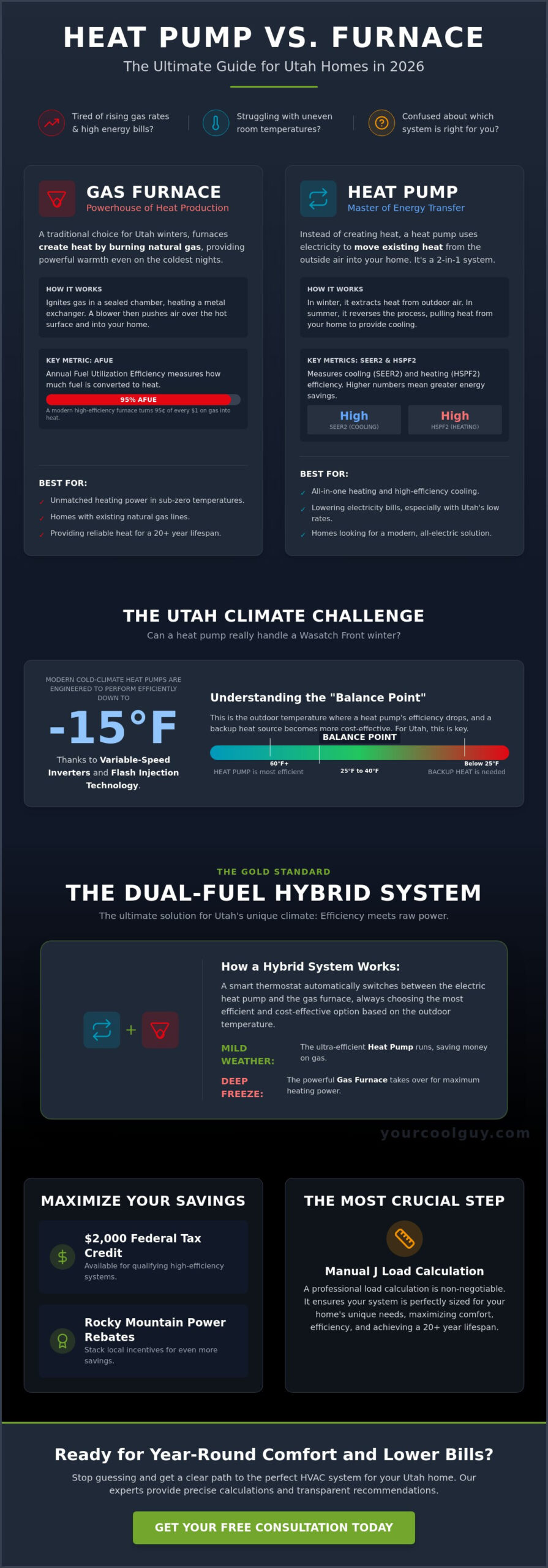
Choosing the right HVAC system starts with understanding how these two technologies actually work. While both aim to keep your living room cozy during a January blizzard, they take completely different paths to get there. A furnace is a combustion based system. In our neck of the woods, that usually means it burns natural gas to create fire, which then warms up a component called a heat exchanger. It’s a powerhouse of heat production, making it a traditional favorite for the heat pump vs furnace for Utah homes debate.
A heat pump is different because it doesn’t actually create heat. Instead, it uses electricity to move existing thermal energy from one place to another. Even when it feels freezing outside, there’s still heat energy in the air that a heat pump can grab and pull indoors. The best part? It’s a two-for-one deal. In the summer, the system simply flips a switch and pumps the heat out of your house, acting as a high-efficiency air conditioner. Whether you live in Plain City or Ogden, both systems are designed to work perfectly with your home’s existing ductwork, so you won’t need a massive renovation to upgrade.
How a Furnace Generates Heat
When your thermostat clicks on, your furnace ignites gas in a sealed chamber. This process creates hot flue gases that travel through the heat exchanger. Your blower fan then pushes air over that hot metal and into your home. Efficiency is measured by the AFUE (Annual Fuel Utilization Efficiency) rating. A 95% AFUE furnace turns 95 cents of every dollar spent on gas into actual heat. If your older unit is struggling to keep up or making strange noises, you might need expert furnace repair in Layton to ensure your heat exchanger is safe and your combustion process is clean. High-efficiency furnaces are built for the long haul, often lasting 20 years with proper care.
How a Heat Pump Moves Heat
Think of a heat pump like a refrigerator running in reverse. While a fridge pulls heat out of its cabinet to keep your milk cold, a heat pump pulls heat from the outdoor air to keep your bedroom warm. If you’ve ever wondered, What is a heat pump?, it’s essentially a master of energy transfer. During those scorching July afternoons in Utah, the cycle reverses to provide crisp, reliable cooling. In 2026, we look at SEER2 for cooling efficiency and HSPF2 for heating performance. These modern standards ensure you’re getting the most “move” for your money. It’s a sleek, electric solution that handles all four seasons without breaking a sweat.
The precision required for these installations is a standard held by experts globally; for example, Alfa-Thermo specializes in ensuring that heat pumps and air conditioning systems are perfectly calibrated for year-round reliability.
The Cold Reality: Performance in Utah’s Freezing Temperatures
Don’t believe the rumor that heat pumps give up the ghost as soon as the first snowflake hits the ground in Ogden. That might have been true twenty years ago, but 2026 technology has flipped the script. Many homeowners still assume a gas furnace is the only way to survive a Wasatch Front winter. While gas is a powerhouse, modern Cold Climate Heat Pumps (CCHP) are specifically engineered to handle sub-zero performance. These units can pull heat from the air even when it’s -15°F outside, making them a viable energy-efficient alternative to traditional systems.
The real secret to mastering the heat pump vs furnace for Utah homes debate is understanding the “balance point.” This is the outdoor temperature where a heat pump’s efficiency starts to dip and it might need a little help from a backup source. In Utah, this point usually hits between 25°F and 40°F. Since our electricity rates are roughly 22% below the national average at 14¢/kWh, running a heat pump is incredibly cost-effective for the majority of the winter. When the temperature drops into the single digits, that’s when a furnace or a backup electric strip takes the lead to ensure you never wake up to a chilly house.
Modern Efficiency vs. Traditional Limits
Older heat pumps were either “on” or “off,” which led to those annoying temperature swings and high bills. Today’s systems use variable-speed inverters that act like a dimmer switch, adjusting their output to match your home’s exact needs. Flash injection technology allows modern compressors to maintain high heating capacity even when outdoor temperatures plummet toward sub-zero levels. This precision is why we insist on a professional load calculation for every home in Farr West. If your system is sized incorrectly, you’ll lose out on those 2026 efficiency gains regardless of which technology you choose. If you’re curious about how your current setup measures up, our team can perform a comprehensive system evaluation to help you plan your next move.
Indoor Air Quality During Inversions
We all know the “Red Air” days that plague Ogden and Layton during winter inversions. When the valley traps pollutants, choosing an electric-assisted heating system helps reduce on-site emissions from your own chimney. Modern heat pumps also feature advanced blowers that provide constant air filtration without the massive energy spike of a traditional furnace fan. This keeps your home’s air moving through high-quality filters 24/7. To truly breathe easy during inversion season, pairing your system with dedicated indoor air quality Ogden solutions can make a world of difference for your family’s health.
Comparing Installation Costs, Monthly Bills, and ROI
Let’s talk numbers because that’s where the rubber meets the road for most families. When you’re weighing a heat pump vs furnace for Utah homes, you have to look past the sticker price and consider the total cost of ownership. A traditional furnace replacement often requires you to also update your air conditioner to ensure the systems play nice together. In contrast, a heat pump is a single unit that handles both jobs. While the initial investment for a high-end heat pump might look higher on paper, the financial math changes fast once you factor in the massive incentives available in 2026.
Maintenance is the secret sauce for longevity. A well-kept gas furnace can hum along for 18 to 22 years, while a heat pump usually works hard for 14 to 18 years since it runs year-round. To get the best return on your investment, you need to look at the life cycle costs of each system. With Utah’s electricity rates sitting comfortably at 14¢/kWh, which is about 22% below the national average, the long-term ROI for electric-assisted heating has never looked better for our local homeowners.
Upfront Investment and Rebates
The 25C Energy Efficient Home Improvement Credit is a game changer for 2026. This federal tax credit covers 30% of your total project cost, including labor, up to a maximum of $2,000 per year. You can also stack this with Rocky Mountain Power Wattsmart rebates, which offer up to $2,000 for qualifying cold-climate models. Choosing the “cheapest” standard furnace might save a few dollars today, but you’ll likely spend far more over the next decade in missed tax breaks and higher monthly energy consumption. We always help our neighbors in Plain City and Ogden navigate these forms so they don’t leave money on the table.
Long-Term Energy Savings
Operational costs are shifting in favor of electricity. As of January 1, 2026, natural gas rates in Utah saw a 4.8% base rate increase, adding more weight to every winter heating bill. Modern variable-speed systems are excellent at preventing “short-cycling” in West Haven homes, where a system constantly kicks on and off and wastes energy. While a high-efficiency gas furnace tops out at around 96% AFUE, a modern heat pump can operate at 300% efficiency or higher by moving heat rather than burning fuel. This massive efficiency gap means that as gas prices continue to climb, the heat pump becomes the clear winner for protecting your monthly budget.
The Dual-Fuel Secret: Why Hybrid Systems are Utah’s Best Choice
A dual-fuel system pairs a high-efficiency electric heat pump with a reliable gas furnace. It’s the ultimate answer to the heat pump vs furnace for Utah homes debate because it doesn’t force you to choose one over the other. You get the surgical efficiency of electricity for about 80% of the year and the raw, blazing power of natural gas for those brutal weeks when the temperature stays below zero. This setup isn’t just about comfort; it’s about giving you total control over your utility bills as energy prices continue to shift in 2026.
The smart thermostat is the MVP of this operation. It acts as a brain that constantly monitors outdoor temperatures and current utility rates. When it’s a crisp 45 degrees in North Ogden, the heat pump hums along cheaply to maintain your perfect indoor climate. If a canyon wind drops the mercury to 10 degrees, the system automatically tags in the gas furnace to take over the heavy lifting. It’s like having a fuel-efficient hybrid car that can instantly turn into a heavy-duty 4×4 when the snow gets deep.
The Automatic Switchover Logic
This switch happens at the balance point we discussed earlier, which usually falls between 25 and 40 degrees depending on your home’s insulation. The transition is completely seamless. You won’t even notice it happening except for the change in vent temperature. While heat pumps deliver steady, mild warmth, gas furnaces produce air between 110 and 130 degrees. This “hot” air feels much more satisfying when you’re coming in from a blizzard. To keep these complex systems running perfectly, you’ll want to stay on top of maintenance. If you notice your system cycling strangely, don’t hesitate to call for expert heat pump repair in Clearfield to keep your hybrid logic sharp.
Is Dual-Fuel Right for Your Home?
If your home already has an existing gas line, adding a heat pump during your next furnace replacement is a smart move. Many homeowners in Syracuse and Clinton are choosing this path for the added layer of redundancy. If your heat pump has a minor electrical issue, you still have gas heat to keep the pipes from freezing. If natural gas rates continue their upward trend, you can lean harder on the electric side of your system. It’s an insurance policy for your comfort. If you want to see how a hybrid system fits into your specific floor plan, contact our team for a custom home energy assessment today.
Choosing Your System: How E.R.S. Heating & Cooling Helps
Deciding on the winning setup in the heat pump vs furnace for Utah homes debate is a big move for your family’s comfort and your bank account. You don’t have to navigate these technical specs alone. At E.R.S. Heating & Cooling, we’ve spent over 20 years serving our neighbors in Plain City and throughout Weber and Davis Counties. We’re a local, family owned business that understands exactly how a canyon wind or a week of sub-zero inversions feels. Our goal isn’t just to sell you a box; it’s to design a system that works specifically for your home’s unique footprint—much like how specialized experts such as Industriële verwarming tailor solutions for massive industrial halls and warehouses.
We believe in total transparency and a stress-free experience. Whether you’re leaning toward a high-efficiency furnace, a modern cold-climate heat pump, or the popular dual-fuel hybrid approach, we’ll walk you through the pros and cons for your specific budget. We handle the paperwork for those 2026 federal tax credits and Rocky Mountain Power rebates so you can focus on staying cozy. Our team is committed to clean, fast, and reliable installations that respect your home and your time.
The E.R.S. Difference: Professional Sizing
Most HVAC issues start with a “rule of thumb” guess. If a contractor just looks at your square footage and picks a unit, you’re headed for trouble. An oversized system will short-cycle, constantly kicking on and off, which wears out parts and spikes your bills. An undersized unit will run forever and never keep you warm. We use detailed Manual J load calculations for every project. This process accounts for your insulation levels, window orientations, and even the way the sun hits your roof in Farr West. It’s the only way to ensure your new system lasts its full 20-year lifespan. Plus, we provide 24/7 support for every system we install. If you ever face a midnight breakdown, our emergency HVAC repair Davis County team is ready to jump into action.
Start Your Comfort Journey Today
Your home should be your sanctuary, not a place where you have to wear a parka in the kitchen. We’re ready to help you find the perfect balance of efficiency and power. Our expertise isn’t limited to residential basements, either. We bring that same level of precision to local businesses, offering specialized commercial refrigeration repair Ogden UT services to keep our community running smoothly. If you’re ready to lower your utility bills and enjoy year-round comfort, let’s chat. Schedule your HVAC consultation with E.R.S. today! We’ll provide a custom quote and a clear path to a more comfortable home.
Secure Your Year-Round Comfort Today
Navigating the heat pump vs furnace for Utah homes debate doesn’t have to be a headache. Whether you choose the raw power of a gas furnace, the high-tech efficiency of a heat pump, or the versatile logic of a dual-fuel hybrid, 2026 is the year to upgrade. By stacking federal tax credits with local rebates, you can finally achieve that perfect balance of lower utility bills and even temperatures throughout your home. Remember that precise sizing and professional installation are the real keys to making sure your investment lasts for the next 20 years.
Our family-owned team in Plain City is here to make the process smooth and professional. With over 20 years of local Utah experience, E.R.S. Heating & Cooling understands the specific demands our winters place on your HVAC system. We provide 24/7 emergency service to ensure you’re never left in the cold. Ready to see which system fits your lifestyle best? Book Your Free Home Comfort Assessment with E.R.S. Heating & Cooling today. Let’s build a more comfortable, efficient future for your home together.
Frequently Asked Questions
Is a heat pump enough for a Utah winter?
Yes, modern cold-climate heat pumps are absolutely capable of keeping your home warm during a typical Utah winter. These advanced units are designed to operate efficiently even when outdoor temperatures drop to -15°F. While older models struggled in the frost, 2026 technology ensures you stay cozy without needing a backup heat source for the vast majority of the season.
How much can I save with a heat pump tax credit in 2026?
You can claim the federal 25C tax credit, which covers 30% of the total project cost up to a maximum of $2,000 per year. This credit is available through 2032 and can be combined with local Rocky Mountain Power rebates. Qualifying cold-climate systems can earn you an additional $2,000 in utility rebates, making the transition to high-efficiency equipment much more affordable.
Do heat pumps last as long as traditional furnaces?
Heat pumps typically have a lifespan of 14 to 18 years, which is slightly shorter than the 18 to 22 years expected from a gas furnace. This difference exists because a heat pump works year-round to provide both heating and cooling. A furnace only operates during the colder months, while your heat pump is your primary comfort provider for all four seasons.
What is the difference between a standard heat pump and a cold-climate heat pump?
Standard heat pumps begin to lose their heating capacity as temperatures dip toward freezing, but cold-climate models use variable-speed inverters to maintain performance. These specialized units often feature flash injection technology to stay powerful in sub-zero weather. Choosing the right cold-climate model is essential for the heat pump vs furnace for Utah homes comparison to work in your favor.
Can I add a heat pump to my existing gas furnace?
You can definitely add a heat pump to your current setup to create a dual-fuel or hybrid system. This is an excellent move if your air conditioner is failing but your furnace still has years of life left. The new heat pump replaces your old AC unit and takes over the heating duties during the milder spring and fall months.
How do electricity costs in Utah compare to natural gas for heating?
Utah’s residential electricity rates are approximately 14¢/kWh, which sits about 22% below the national average. While natural gas remains a powerful fuel source, Enbridge Gas implemented a 4.8% base rate increase in early 2026. Because heat pumps move heat rather than creating it, they can often be more cost-effective than gas during the long stretches of 30 to 50-degree weather.
Will a heat pump make my home feel colder than a furnace does?
A heat pump won’t make your home colder, but the air coming out of the vents feels different. Gas furnaces blast air at 110 to 130°F, while heat pumps deliver a steady stream of air closer to 90 or 100°F. It’s still plenty warm enough to heat your home, but it feels more like a gentle, consistent warmth rather than a hot breeze.
What maintenance does a hybrid dual-fuel system require?
A hybrid system requires professional maintenance twice a year to ensure both the electric and gas components are ready for their respective seasons. You’ll want a spring checkup to prep the heat pump for summer cooling and a fall visit to inspect the furnace burners and heat exchanger. Keeping both sides of the system clean is the best way to ensure it lasts the full 20 years.