

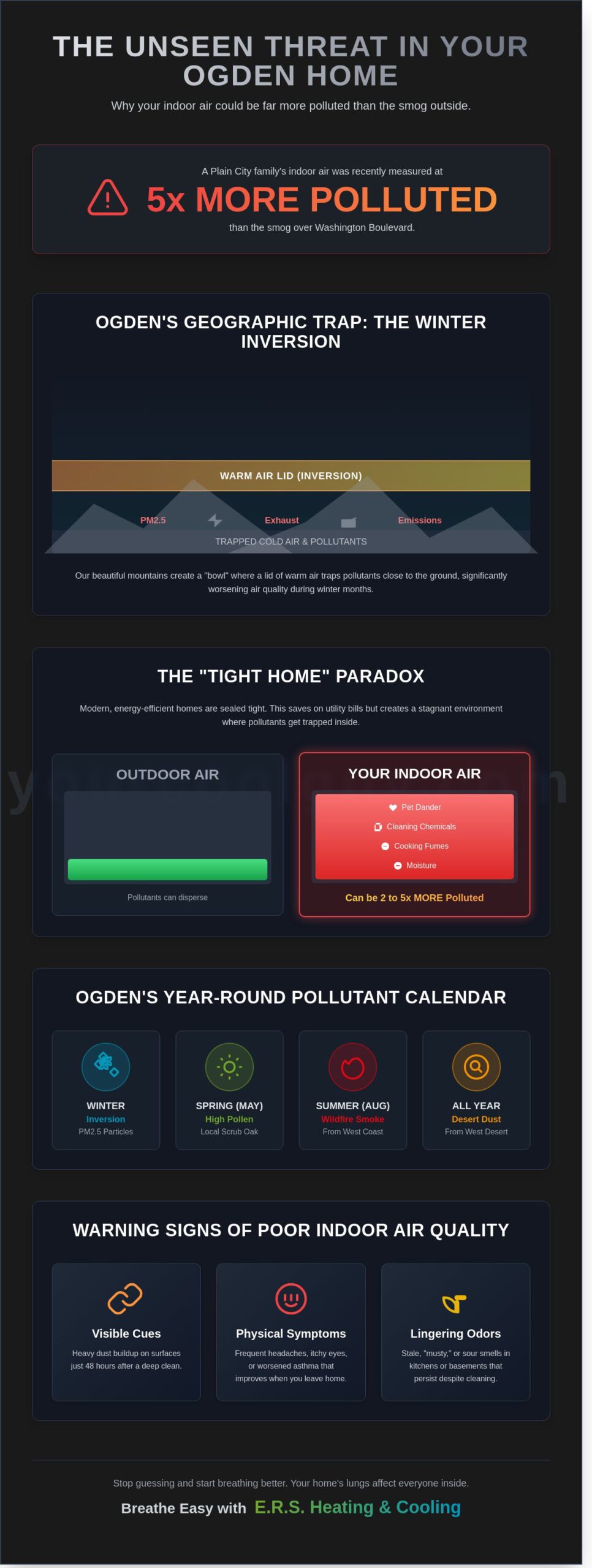
Last Tuesday, a family in Plain City discovered that their living room air was 5 times more polluted than the smoggy haze sitting over Washington Boulevard. You think you’re safe inside once the doors are shut, but the Ogden inversion has a way of sneaking into your space. We all know that heavy feeling in our lungs during the winter months. It’s frustrating to deal with itchy eyes and constant dust while the mountains are hidden by a thick, gray blanket. You aren’t alone in wanting a home that feels like a breath of fresh mountain air instead of a dusty basement.
You deserve to relax without worrying about the next Air Quality Alert. This guide gives you the exact tools to boost your indoor air quality Ogden and turn your home into a clean, fresh sanctuary. We’ll break down which high-efficiency filters actually stop 99 percent of pollutants and how to balance Utah’s dry air so your skin finally stops peeling. It’s time to stop guessing and start breathing better with a few simple, professional moves that make a real difference.
Key Takeaways
- Understand how Ogden’s unique mountain geography affects indoor air quality Ogden and why winter inversions make home filtration a must.
- Discover the best ways to test for PM2.5 and VOCs, from simple DIY kits to high-precision professional audits.
- Master the five essential steps to refresh your air today, including the secret to picking the right furnace filter for your system.
- Go beyond standard filters with advanced air scrubbers and UV lights that actively kill bacteria and neutralize hidden contaminants.
- See how a “Clean Work” approach leaves your home fresher and healthier without the typical contractor mess or stress.
What is Indoor Air Quality (IAQ) and Why Does Ogden Struggle?
When we talk about your home’s health, we have to start with the basics. What is Indoor Air Quality? Simply put, it’s the measurement of pollutants, gases, and moisture levels inside your living space. It’s the air you and your family breathe for roughly 90 percent of your lives. For those of us living along the Wasatch Front, managing indoor air quality Ogden is a unique challenge that goes beyond just changing a filter once a year.
Ogden sits in a geographic bowl. Our stunning mountains are great for hiking, but they act like a massive stone wall. During the winter, this geography creates a trap. We also deal with specific local triggers that most of the country doesn’t see. Smoke from West Coast wildfires often settles in our valley during August. High pollen counts from local scrub oak peak every May. Even fine desert dust from the West Desert can find its way into your vents. Your home should be a sanctuary from these elements, but often it becomes a storage unit for them.
There’s also a “Tight Home” paradox to consider. Modern homes in Weber County are built to be incredibly energy efficient. We seal every crack to keep the heat in. While this saves money on your utility bill, it creates a stagnant environment. Without a dedicated ventilation strategy, pollutants like pet dander, cleaning chemicals, and moisture stay trapped. Research shows that indoor air can be two to five times more polluted than outdoor air because of this lack of circulation.
The Ogden Inversion Explained
The Ogden Inversion is a weather phenomenon where warm air acts as a lid over the valley. This “lid” prevents the cold air at the surface from rising and dispersing. All the vehicle exhaust and industrial emissions stay pinned against the ground. Many people think opening a window for fresh air is a good idea. In January, that’s a mistake. Doing so pulls high concentrations of PM2.5 particles directly into your bedrooms, making your indoor environment significantly worse than if you kept the windows shut.
Signs Your Home Has Poor Air Quality
Your home will give you clear signals when the air is getting thick. You just need to know where to look. Common indicators include:
- Visible cues: You notice heavy dust buildup on flat surfaces in Plain City or North Ogden homes within 48 hours of a deep clean.
- Physical symptoms: Family members experience frequent headaches, itchy eyes, or worsened asthma that seems to disappear when they leave the house for work or school.
- Odors: You notice stale, “musty,” or sour smells that linger in the kitchen or basement regardless of how much you clean.
If you’re seeing these signs, it’s time to stop guessing and start acting. Your home’s lungs are likely clogged, and that affects everyone living inside.
How to Test Your Home Air Quality in Weber County
Testing isn’t just for lab techs in white coats. You can’t fix what you can’t see, and in Northern Utah, what you can’t see is often the biggest problem. To get a real handle on your indoor air quality Ogden homes require a mix of tech and timing. The EPA recently tightened safety targets; by 2026, the annual standard for PM2.5 will drop to 9.0 micrograms per cubic meter. This represents a 25% reduction from previous limits, meaning your home needs to be cleaner than ever to stay within healthy ranges.
You need to track three big players: PM2.5 (tiny particles from smoke or traffic), Carbon Dioxide (CO2), and Volatile Organic Compounds (VOCs). These common pollutants indoors often spike during our famous winter inversions or when summer wildfires drift into the valley. Testing in both January and July is the only way to see how your HVAC system handles Utah’s extreme seasonal shifts. A home that breathes fine in May might become a trap for pollutants once the furnace kicks on in December.
DIY Air Quality Monitors
Consumer-grade monitors like Airthings or PurpleAir are great for real-time tracking. They’re affordable and sync right to your phone. For the best results, place your monitor 3 to 5 feet off the floor in a “breathing zone” like your bedroom or living room. Don’t put it right next to a window or an air vent, or you’ll get a false reading. If the numbers jump 40% when you’re searing a steak, don’t panic. It’s the long-term averages that actually impact your health, not a temporary spike from dinner.
When to Call a Professional for an Audit
Sometimes a $150 sensor isn’t enough. If you live in one of Ogden’s beautiful older neighborhoods like the East Bench, your home might have hidden risks that basic sensors miss. Pre-1960 houses often have basement cracks that let radon seep in, or old insulation that traps moisture. A professional audit uses calibrated equipment to find mold spores or chemical off-gassing from that new memory foam mattress you bought last month. It’s smart to get a baseline reading before you drop thousands on new equipment. You’ll know exactly what you’re fighting, and we can help you pick the right gear to win that battle for your indoor air quality Ogden goals.
5 Steps to Improve Your Indoor Air Quality Today
You want a home that feels fresh, not stuffy. Taking control of your indoor air quality Ogden starts with simple, actionable moves. It’s about being proactive rather than waiting for dust to pile up on your baseboards. You don’t need a massive renovation to see results; you just need a better strategy for your HVAC system and daily routines.
Choosing the Right Filter for Utah Homes
Most standard fiberglass filters only stop large debris from hitting your blower motor. To actually clean your air, you need a higher MERV rating. For Ogden residents, MERV 11 to 13 is the sweet spot. It provides professional-grade filtration without putting too much strain on your furnace motor. A MERV 13 filter is powerful enough to capture 90% of smoke particles, which is vital during Utah’s summer wildfire season. Swap these out every 60 to 90 days. If you have pets or high pollen counts in May, check them every 30 days to keep the airflow smooth. Regular filter changes are just one part of maintaining your system; proper HVAC Utah maintenance scheduling ensures your entire system operates at peak efficiency year-round.
Practical Daily Habits
Good air quality is a lifestyle. Start with a strict “No-Shoes” rule. This simple change keeps 80% of outdoor pollutants, like Plain City dust and lawn chemicals, out of your carpets. Run your kitchen exhaust fan for at least 10 minutes after cooking to clear out nitrogen dioxide and moisture. Don’t forget your pets; groom them outdoors twice a week to stop dander before it hits your floor. These small wins add up fast and keep your “clean work” environment pristine.
Beyond the daily basics, focus on these three pillars to keep your air crisp:
- Control Moisture: Keep your home’s humidity between 30% and 50%. This range stops mold spores from activating in damp bathrooms or basements.
- Reduce VOCs: Choose paints and building materials labeled “Low-VOC” or “Zero-VOC.” Traditional cleaners can off-gas chemicals for weeks after use.
- Strategic Ventilation: Strategic ventilation is a game-changer for indoor air quality Ogden homeowners often overlook. Open your windows only when the local AQI is below 50. This flushes out stale air without letting in mountain valley smog.
Following these steps will help you improve the indoor air quality in your home starting this afternoon. It’s all about making your living space a sanctuary where you can breathe easy. If you stay consistent with your HVAC cleaning schedule, you’ll prevent dust recirculation and keep your system running like a pro.
Advanced IAQ Solutions: Scrubbers, UV, and Humidity
Standard furnace filters stop dust from hitting your blower motor, but they don’t actually clean your air. To truly transform your indoor air quality Ogden homes need active technology that hunts down pollutants. We’re moving past passive mesh screens into the world of molecular-level purification.
Air Scrubbers and HEPA Filtration
Air scrubbers use NASA-inspired technology originally designed for the International Space Station. Unlike a standard filter that waits for dust to float through it, an air scrubber actively sends out ions that attach to particles and neutralize them before they reach your lungs. These systems work best when paired with regular maintenance; scheduling professional HVAC Utah tune-ups ensures your advanced filtration systems operate at maximum effectiveness throughout Utah’s challenging seasonal transitions.
Breathe Easy with E.R.S. Heating & Cooling
You deserve a home that feels like a sanctuary. For 22 years, E.R.S. Heating & Cooling has helped families across the Wasatch Front breathe better. We don’t just swap filters; we engineer solutions for the specific challenges of our high-desert climate. Whether you live in Plain City, Ogden, or Layton, our team understands how local inversions and seasonal pollen impact the indoor air quality Ogden families deal with every year. We’ve completed over 5,200 service calls in Weber County, giving us a unique perspective on the specific pollutants that enter your ductwork.
Our “Clean Work” promise isn’t just a marketing slogan; it’s a guarantee that we respect your space. We treat your living room like our own. Our technicians wear floor protectors and use heavy-duty drop cloths on every single job. When we finish an installation, your home will be cleaner than when we arrived. We’ve maintained a 4.9-star rating by focusing on these small details that other contractors skip. You get professional results without the messy cleanup.
Local expertise is vital because Ogden’s air isn’t like the air in Florida or California. We deal with extreme dry spells and heavy winter inversions that trap particulate matter near the valley floor. We select equipment designed to handle these specific shifts, ensuring your system doesn’t just run, but thrives. Our customized IAQ packages are built to combat the 99.97% of particulates that often trigger local allergies.
Our Professional IAQ Process
- Phase 1: Comprehensive Testing. We start with professional-grade sensors to check for VOCs, humidity imbalances, and particulate matter. We also perform a 20-point duct inspection to find hidden dust traps.
- Phase 2: Tailored Recommendations. We create a custom package based on your family’s health needs. This might include HEPA filtration or UV air purifiers that neutralize 98% of airborne bacteria.
- Phase 3: Expert Installation. We install your new gear with precision and provide 24/7 support. You’ll never be left wondering how your system works.
Contact Your Local Cool Guys
Ready to clear the air? We’re proud to serve Weber and Davis Counties with a smile and the best tools in the business. Don’t let poor indoor air quality Ogden winters cause respiratory stress for your family. We’re the “good guy” pros who talk to you like a neighbor, not a number. Reach out today to see why your neighbors have trusted us for over two decades.
Ready for a Fresher, Healthier Ogden Home?
Living in the shadows of the Wasatch Range means dealing with unique atmospheric shifts that directly impact your home’s atmosphere. You now know that monitoring humidity levels and utilizing advanced UV air scrubbers can eliminate up to 99 percent of airborne contaminants. Don’t let the next inversion season dictate how you feel inside your own four walls. We’ve spent 20+ years helping our neighbors breathe easier with professional solutions that actually work.
As a family-owned and operated team, we treat your comfort like our own. Whether it’s a routine check or a midnight HVAC crisis, our 24/7 emergency support ensures you’re never left in the lurch. We make the process of optimizing indoor air quality Ogden residents trust completely seamless and stress-free. It’s time to stop worrying about what’s in your lungs and start enjoying the crisp, clean environment you deserve.
Book Your Ogden Indoor Air Quality Audit Now
Let’s get your home feeling cool, clean, and perfectly comfortable today.
Frequently Asked Questions
Is indoor air quality really worse than outdoor air in Ogden?
Yes, indoor air is typically 2 to 5 times more polluted than outdoor air according to EPA data. While Ogden faces tough outdoor conditions during winter inversions, trapped pollutants like pet dander and cleaning chemicals build up inside your walls. You spend 90% of your time indoors, so managing your indoor air quality Ogden is actually your biggest health priority.
How often should I change my air filter during a Utah wildfire season?
You should change your air filter every 30 days when wildfire smoke hits the Wasatch Front. Standard filters that normally last 90 days will clog 3 times faster when PM2.5 levels spike above 50 micrograms per cubic meter. Check your filter every 2 weeks during August; if it looks gray or ashy, swap it out immediately to protect your blower motor.
Does a humidifier actually help with indoor air quality?
A humidifier improves air quality by keeping your home’s relative humidity between 30% and 50%. Utah’s desert climate often drops indoor humidity below 15% in winter, which allows viruses to stay airborne longer. Maintaining the right moisture levels makes dust heavier so it falls out of the air instead of entering your lungs. It’s a simple fix for a much healthier home environment.
What is the best MERV rating for a home in Weber County?
A MERV 11 or MERV 13 filter is the ideal choice for most Weber County residential HVAC systems. These ratings capture 85% to 90% of particles like pollen and smoke without putting excessive strain on your furnace. Avoid MERV 16 filters unless your system is specifically designed for them, as they can restrict airflow by up to 40% and cause equipment failure.
Can indoor plants actually clean my home’s air?
No, you would need roughly 10 plants per square foot to see a measurable difference in air purity. While a 1989 NASA study showed plants can absorb VOCs, real-world homes have too much air exchange for greenery to keep up. They look great and boost your mood, but a dedicated air purifier is 100 times more effective at removing toxins from your living space.
How much does a whole-home air purifier cost to install in Ogden?
Most Ogden homeowners pay between $800 and $2,500 for a professional whole-home air purifier installation. A basic bypass HEPA system starts on the lower end, while advanced UV-C light systems or electronic air cleaners usually land around $1,800. These units integrate directly into your existing ductwork to treat 100% of the air circulating through your home every single day.
What should I do during a Red Air Day in Ogden?
Keep all windows and doors tightly shut and set your HVAC fan to “On” rather than “Auto” during Red Air Days. This ensures your air is constantly passing through your filter even when the heater isn’t running. Local health departments recommend reducing physical activity when PM2.5 levels exceed 35.5 micrograms to minimize the amount of polluted air you breathe into your lungs.
Can my HVAC system help remove cooking odors and VOCs?
Your standard HVAC system won’t stop odors unless you add a carbon-infused filter or an active air scrubber. These upgrades use activated charcoal or ionization to neutralize 99% of cooking smells and volatile organic compounds. Improving your indoor air quality Ogden this way means you won’t be smelling last night’s fried fish dinner for the next 48 hours.