

What if your furnace or air conditioner could last five years longer than the manufacturer promised? Most homeowners think a total system failure is just an inevitable part of living in Utah’s high-desert climate, but it doesn’t have to be. If you are wondering how to extend the life of your hvac system West Point weather is often your biggest opponent. Between the dusty summers and freezing winters, your equipment works overtime just to keep up.
We know how frustrating it is to watch your utility bills climb while worrying about a sudden breakdown during a July heatwave. You deserve a home that stays comfortable without the constant fear of an expensive emergency repair. This guide shares professional-grade strategies to maximize your equipment’s lifespan and keep your monthly costs under control. We will cover everything from simple airflow fixes to the latest 2026 refrigerant standards, giving you the confidence that your system will stay reliable for 15 years or more. It is time to stop reacting to problems and start protecting your investment with a few smart, consistent habits.
Key Takeaways
- Learn how a 20-year lifespan is achievable for your equipment, even with the intense temperature swings common in Davis County.
- Discover how to extend the life of your hvac system West Point by mastering the 90-day airflow rule to protect your compressor from burnout.
- Identify the common thermostat habits that cause “short-cycling” and silently wear down your system’s most expensive internal parts.
- Understand why timing your professional tune-ups for spring and fall is the best way to catch invisible leaks before they become emergencies.
- Find out how small, consistent maintenance habits can slash your monthly utility bills while keeping your home perfectly comfortable all year.
Understanding HVAC Lifespan in the West Point Climate
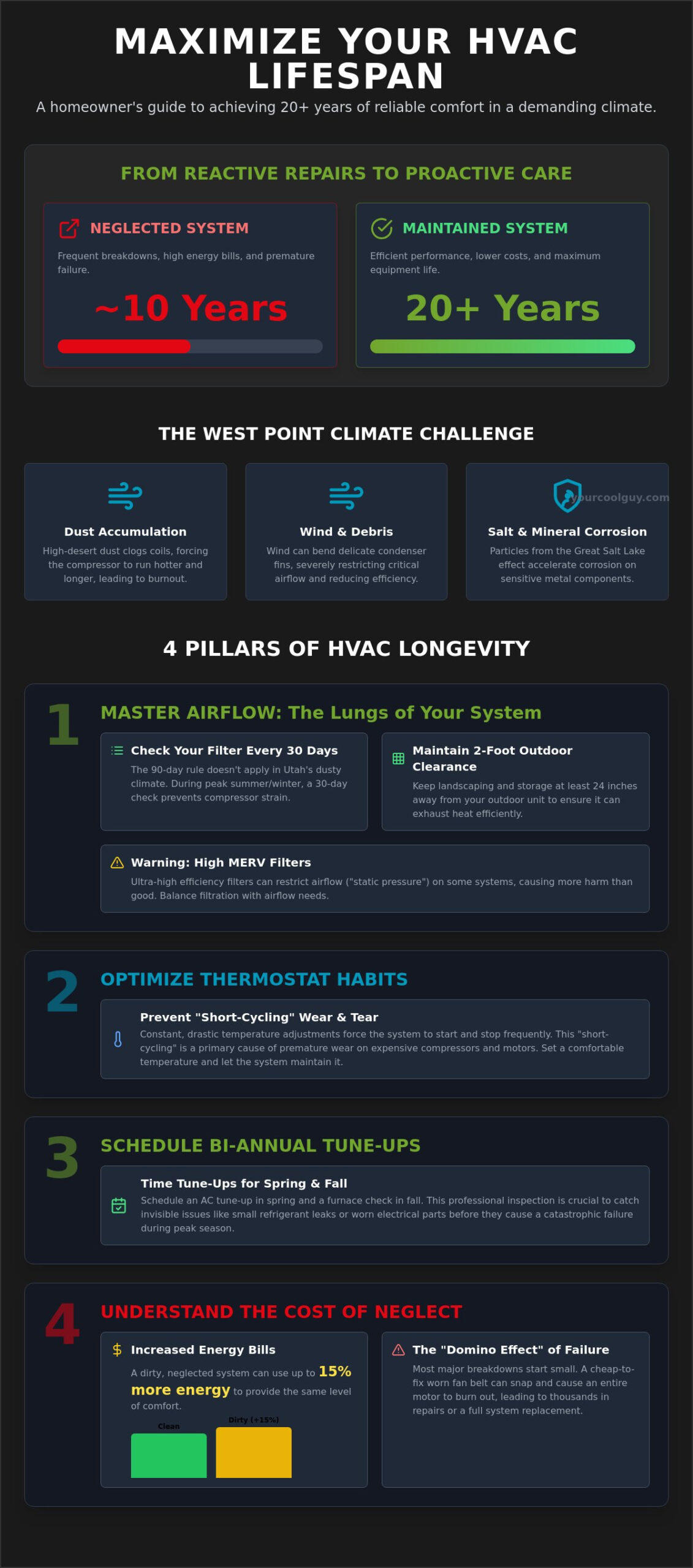
Most modern HVAC systems are engineered to last between 15 and 20 years. It’s a solid number, but it is also a “perfect world” estimate. In West Point, the world is rarely perfect. Our local systems face a brutal cycle of Davis County winters that dip well below freezing and summer heatwaves that frequently push past the 100-degree mark. These extreme temperature swings force your equipment to work harder and cycle more frequently than units in milder regions of the country.
There is also a massive difference between a system that is simply “running” and one that is running efficiently. A unit might still blow air, but if it’s struggling to reach your set temperature, it’s suffering from mechanical fatigue. If you want to know how to extend the life of your hvac system West Point homes require a specific strategy that accounts for this environmental strain. True system health means your unit reaches its target temperature smoothly and maintains it without overworking every internal part.
Why West Point Homes Face Unique HVAC Stress
Our high-desert environment is beautiful, but it’s incredibly tough on machinery. High-desert dust and wind constantly pelt your outdoor condenser coils, acting like sandpaper on the equipment. Even worse, the “Great Salt Lake” effect brings unique mineral dust and salt particles that can accelerate corrosion on sensitive metal components. While we don’t deal with coastal humidity, localized fluctuations in Northern Utah still impact your furnace’s heat exchanger. When these factors combine, your system doesn’t just run; it battles the elements every single day.
- Dust Accumulation: Clogged coils force the compressor to run hotter and longer.
- Wind Damage: Debris can bend delicate fins, restricting vital airflow.
- Salt Corrosion: Microscopic particles eat away at protective coatings over time.
The True Cost of Neglect vs. Proactive Care
Most major breakdowns start as tiny, inexpensive problems. A worn fan belt costs very little to replace, but if it snaps, it can cause the entire motor to burn out in seconds. This creates a domino effect of damage that often ends in a total system failure. There’s also a direct link between how clean your system is and how much you pay the utility company. A dirty system can use up to 15% more energy to provide the same amount of cooling. Preventative maintenance—much like the concrete leveling Arkansas property owners use to protect their foundations—is the professional practice of inspecting and cleaning components early to avoid a $10,000 replacement. By catching these small issues now, you ensure your system remains a reliable asset for two decades instead of a liability that dies at the ten-year mark.
The Airflow Essential: Protecting the ‘Lungs’ of Your System
Airflow isn’t just a comfort issue; it’s a mechanical survival issue. If you’re looking for the secret on how to extend the life of your hvac system West Point homeowners often overlook the simplest fix: letting the system breathe. When air cannot move freely, your compressor and heat exchanger are forced to compensate for the lack of circulation. This extra heat and pressure are the primary causes of premature mechanical failure. Think of your filters and coils as the lungs of the unit. If they are congested, the entire system suffers.
The industry standard is the 90-day filter rule, but that doesn’t always apply in our specific climate. During peak heating and cooling months in Davis County, you should check your filter every 30 days. Dust from the surrounding fields and the Great Salt Lake can turn a clean filter into a clogged barrier much faster than the packaging suggests. Keeping that pathway clear is the easiest way to prevent a mid-summer breakdown.
Choosing the Right Air Filter for Your Utah Home
It is tempting to buy the highest MERV rating available to scrub every particle out of the air. However, “high-efficiency” filters can actually act like a chokehold on older blower motors. This creates “static pressure,” which is basically the mechanical equivalent of high blood pressure for your HVAC. If you have pets or suffer from local pollen allergies, you might need a mid-range filter changed more frequently rather than a heavy-duty one that stays in for months. If your system seems to be struggling with airflow, a quick indoor air quality consultation can help you find the perfect balance between clean air and system longevity.
Maintaining the Outdoor Condenser Unit
Your outdoor unit needs space to exhaust heat efficiently. We recommend the 2-foot rule: keep all landscaping, shrubs, and storage at least 24 inches away from the unit at all times. In West Point, cottonwood seeds and lawn clippings are the biggest enemies of those delicate aluminum fins. You can clean these yourself using a gentle garden hose to wash away the buildup. While high-pressure equipment is excellent for cleaning concrete when handled by a team like Ehrman’s Power Wash, you should never use a power washer on HVAC fins; it will flatten them and permanently restrict airflow. While shading your unit can provide a minor efficiency boost, never wrap it or cover it in a way that traps heat around the compressor.
- Check monthly: Especially during June and January.
- Vacuum vents: Keep indoor return air grilles free of dust and pet hair.
- Clear the perimeter: Ensure no weeds or grass are growing into the unit base.
Smart Thermostat Habits and Technical Optimization
Your thermostat is the brain of the whole operation. If you’re curious about how to extend the life of your hvac system West Point professionals will tell you that smart control habits are just as vital as clean filters. One of the biggest silent killers of HVAC equipment is “short-cycling.” This occurs when your system turns on and off in rapid succession. Every time a motor starts, it faces a surge of electricity and intense heat. Frequent starts wear out the capacitors and the compressor years before they should naturally fail. By managing how often your system kicks on, you’re directly adding years to its lifespan.
There is a common “set it and forget it” myth that suggests keeping your home at one steady temperature 24/7 is the most efficient choice. While you don’t want the system to struggle to recover from extreme shifts, allowing it to rest is essential. Modern equipment isn’t designed to run indefinitely without breaks. Leveraging smart technology helps you reduce total runtime while you are away or asleep, which preserves the mechanical integrity of every moving part.
Optimizing Your Temperature Setpoints
For West Point homes, the goal is to balance personal comfort with system longevity. In the summer, try to keep your thermostat at 78°F when you’re home. During the winter, 68°F is the ideal target for furnace health. When you leave for work, a 7-8 degree setback is the “sweet spot” that saves energy without making the system work too hard to catch up later. A thermostat is a switch, not a gas pedal; setting it to 60° won’t cool the house faster. It only ensures the system runs longer and faces more wear to reach an unreachable goal.
The Benefits of Smart Thermostat Upgrades
Upgrading to a smart thermostat does more than just let you change the temperature from your phone. These devices monitor the “pulse” of your equipment and can send you alerts for filter changes or unusual cycle patterns. They also help with humidity control, which is a major factor in how “heavy” the air feels. Better control means your blower motor doesn’t have to work as hard to make the room feel comfortable. If you’re interested in modernizing your home, you can learn about thermostat upgrades in Layton and how they integrate with your existing setup.
Don’t forget the “Fan” setting on your device. Always keep it on “Auto” rather than “On.” When set to “Auto,” the blower motor only runs during a heating or cooling cycle. Leaving it “On” forces the motor to run 24/7, which leads to premature bearing failure and can even pull moisture back into your home’s air. Small technical choices like this make a massive difference over a decade of use.
Why Professional Tune-Ups are Non-Negotiable
Think of a professional tune-up as a high-tech health screening for your home. While changing filters is a great start, it only covers the surface. If you are serious about how to extend the life of your hvac system West Point experts recommend at least two professional visits per year. A technician sees the “invisible” threats that a homeowner simply can’t detect without specialized diagnostic tools. Catching a tiny refrigerant leak today prevents a total compressor burnout three years from now.
Seasonal timing is everything for long-term reliability. We suggest scheduling your air conditioning service in the spring and your furnace check in the fall. This proactive approach ensures your equipment is ready for the intense Davis County temperature shifts before they actually happen. Beyond just performance, these visits are vital for your family’s safety. We check for carbon monoxide leaks from cracked heat exchangers and look for electrical hazards like “arcing” that could lead to component failure or even a fire.
What Happens During a Professional Tune-Up?
We do more than just a quick look-over. During a furnace visit, we deep-clean the burner assembly and test the ignition system to guarantee winter reliability. For your AC, measuring the refrigerant charge is critical. If the charge is even slightly off, it forces the compressor to work under extreme pressure, which kills it years early. We also tighten every electrical connection and lubricate moving parts to reduce the friction that causes mechanical wear. It is a detailed process that keeps your system running like it just came out of the box.
The ROI of Maintenance Agreements
Many homeowners don’t realize that regular service is often a requirement to keep manufacturer warranties valid. If you can’t show proof of professional maintenance, an expensive part replacement might not be covered. Is an HVAC maintenance plan worth it? For most West Point families, the priority scheduling alone makes it a smart investment. When temperatures hit triple digits, being at the front of the line for service is a massive relief. Ready to get your system in top shape? You can schedule your professional tune-up today to ensure your home stays comfortable and your equipment lasts for the long haul.
- Warranty Protection: Keeps your 10-year or 15-year coverage intact.
- Safety First: Identifies CO leaks and electrical fire risks early.
- Peak Efficiency: Lowers monthly bills by ensuring every part works perfectly.
Trust E.R.S. Heating & Cooling for Your West Point Home
Choosing a partner for your home’s comfort is a big decision. At E.R.S. Heating & Cooling, we’ve spent over 20 years serving West Point and the surrounding Davis County communities. We are family-owned and operated, which means we don’t just see you as another appointment on a calendar. We treat your home with the same care and respect we’d give our own. If you want to know how to extend the life of your hvac system West Point families have trusted our local expertise for decades to keep their equipment running through every season.
Our commitment to “Clean & Fast” service is at the heart of everything we do. We respect your time and your space. Our technicians arrive on schedule, use floor protectors, and ensure the workspace is spotless before they leave. We also understand that HVAC failures don’t follow a 9-to-5 schedule. That is why we provide 24/7 emergency support. Whether your furnace quits on a snowy Sunday night or your AC fails during a record-breaking heatwave, we are ready to help when you need us most.
Comprehensive HVAC Solutions for Northern Utah
Northern Utah presents specific challenges that generic HVAC advice often misses. From intense lake-effect dust to freezing winters, we understand the local building codes and climate better than anyone. Our expertise goes beyond standard residential comfort. We also handle complex commercial refrigeration, including walk-in cooler maintenance and reach-in freezer repair. This deep technical knowledge allows us to troubleshoot residential issues with a level of precision that others might overlook. If you ever face a sudden breakdown, our emergency HVAC repair in Davis County is available around the clock to restore your comfort quickly.
Schedule Your Longevity Checkup Today
We believe in total transparency. Our diagnostic approach is honest, and our pricing is clear from the very start. You’ll never have to guess what you’re paying for or why a specific repair is necessary. We invite you to join our maintenance family and take the stress out of seasonal changes. By staying ahead of small issues, you can ensure your system reaches its full potential. Contact E.R.S. Heating & Cooling to protect your system and secure your home’s comfort for years to come. Let’s work together to make sure your heating and cooling investment pays off for the long haul.
- Local Experience: 20+ years serving the West Point community.
- Clean & Fast: We respect your home and your busy schedule.
- 24/7 Support: Emergency service is always just a phone call away.
- Honest Diagnostics: Transparent pricing with no hidden fees.
Secure Your Home’s Long-Term Comfort
Your HVAC system is a major investment in your home’s value and your family’s daily comfort. By mastering the 90-day airflow rule and adopting smarter thermostat habits, you’re already doing more than most to protect your equipment. Learning how to extend the life of your hvac system West Point style is all about being proactive before the next Utah heatwave or snowstorm arrives. These simple, consistent steps ensure your system stays reliable for decades instead of just years.
E.R.S. Heating & Cooling makes professional maintenance easy and stress-free. We bring over 20 years of local experience to every service call. As a family-owned and operated Utah business, we pride ourselves on transparency and treating every home like our own. We even offer 24/7 emergency service for those times when life doesn’t go as planned. Schedule your seasonal HVAC tune-up with E.R.S. Heating & Cooling today! You deserve a home that stays perfectly comfortable, and we’re ready to help you keep it that way.
Frequently Asked Questions
How often should I really change my air filter in West Point?
You should check your filter every 30 days and replace it at least every 90 days. In West Point, the high-desert dust and wind often clog filters much faster than the manufacturer suggests. If you have pets or suffer from local allergies, a monthly swap during the peak of summer or winter is the best way to maintain airflow. This simple habit is the easiest answer for how to extend the life of your hvac system West Point homeowners can do themselves.
Will a smart thermostat actually help my HVAC system last longer?
Yes, a smart thermostat helps by preventing inefficient “short-cycling” and managing the system’s total workload. These devices use algorithms to reach your target temperature without constant on-and-off transitions that wear out motors. By reducing unnecessary runtime while you’re away or asleep, you significantly lower the mechanical stress on your compressor. It’s a small technical upgrade that pays off in added years of equipment life and lower monthly energy consumption.
Is it worth repairing an HVAC system that is over 15 years old?
It depends on the “50% rule,” where you compare the repair cost to half the price of a new system. If a repair for a 15-year-old unit costs more than half of a replacement, investing in new equipment is usually smarter. Older systems also use refrigerants like R-410A, which are being phased out as of 2026. A new installation often saves you more in monthly energy bills than keeping an old, struggling unit alive.
Why does my AC unit outside need so much space around it?
Your outdoor unit needs at least two feet of clear space to exhaust heat properly. If the unit is crowded by shrubs, fences, or debris, it cannot “breathe,” which causes the compressor to overheat. This extra heat forces the system to run longer cycles, leading to higher energy bills and a shorter mechanical lifespan. Keeping the area clear ensures the aluminum fins can pull in enough air to keep the internal components at a safe temperature.
Can I perform my own HVAC maintenance to save money?
You can handle basic tasks like changing filters and hosing off the outdoor condenser, but technical maintenance requires a professional. Experts check for refrigerant levels, electrical hazards, and carbon monoxide leaks that homeowners cannot see. Attempting to service internal components yourself can also void your manufacturer’s warranty. Stick to the external cleaning and leave the technical diagnostics to a certified technician to ensure your system remains safe and efficient for years to come.
What are the warning signs that my system is struggling and needs a tune-up?
Strange noises, frequent cycling, and rising utility bills are the most common red flags. If you hear banging or squealing, it usually points to a failing motor or a loose belt that needs immediate attention. Uneven temperatures between rooms also suggest your system is struggling to keep up with the demand. Catching these signs early during a routine checkup prevents a minor annoyance from turning into a total system failure during a Davis County heatwave.
Does West Point’s hard water or dust affect my heating and cooling system?
Dust is a major factor in West Point, as it coats the outdoor coils and restricts the heat transfer process. While hard water doesn’t directly impact your AC, it can cause significant scale buildup in whole-home humidifiers attached to your furnace. This buildup reduces the humidifier’s efficiency and can lead to leaks if the water lines become clogged. Regular cleaning of these specific components is essential for maintaining your indoor air quality and overall system health.
Is a maintenance agreement better than just calling when something breaks?
A maintenance agreement is superior because it focuses on prevention rather than reaction. These plans usually include priority scheduling, which is a lifesaver when West Point temperatures hit extremes and repair calls skyrocket. Most manufacturers also require proof of professional service to keep your warranty valid. By joining a plan, you ensure your system gets the care it needs exactly when it needs it, often saving you from the high cost of emergency repairs.